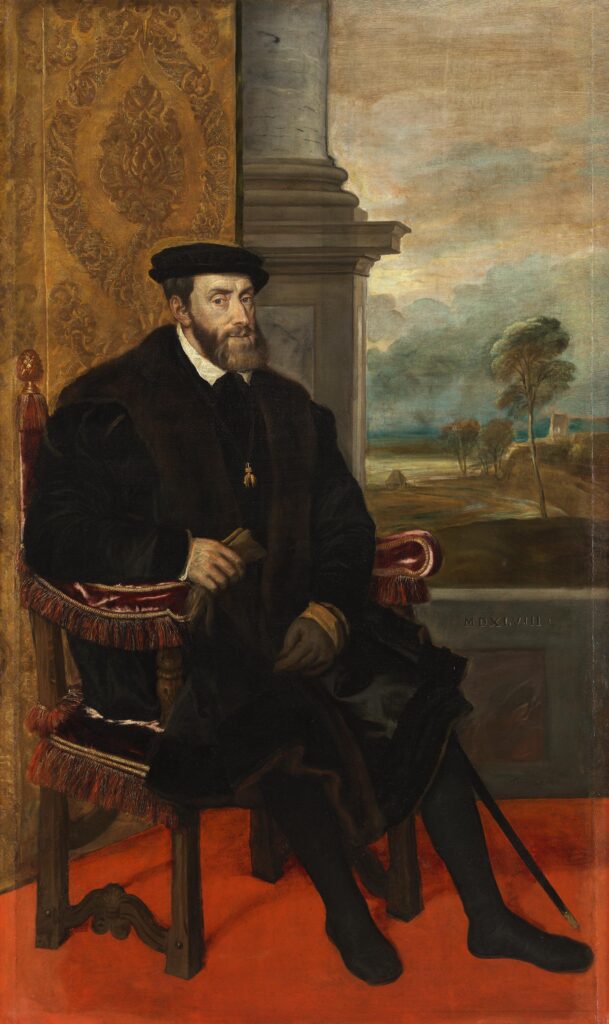
Charles V
(24 February 1500 – 21 September 1558) Holy Roman Emperor and Archduke of Austria from 1519 to 1556, King of Spain (as Charles I) from 1516 to 1556, King of Sicily and Naples from 1516 to 1554, and also Lord of the Netherlands and titular Duke of Burgundy (as Charles II) from 1506 to 1555. He was heir to and then head of the rising House of Habsburg. His dominions in Europe included the Holy Roman Empire, extending from Germany to northern Italy with rule over the Austrian hereditary lands and Burgundian Low Countries, and Spain with its possessions of the southern Italian kingdoms of Sicily, Naples, and Sardinia. In the Americas, he oversaw the continuation of Spanish colonization and a short-lived German colonization. The personal union of the European and American territories he ruled was the first collection of realms labelled “the empire on which the sun never sets”.
Charles was born in Flanders to Habsburg Archduke Philip the Handsome, son of Maximilian I, Holy Roman Emperor and Mary of Burgundy, and Joanna of Castile, younger child of Isabella I of Castile and Ferdinand II of Aragon, the Catholic Monarchs of Spain. Heir of his grandparents, Charles inherited his family dominions at a young age. After his father’s death in 1506, he inherited the Habsburg Netherlands in the Low Countries. In 1516, he became King of Spain as co-monarch of Castile and Aragon with his mother. Spain’s possessions included the Castilian colonies of the West Indies and the Spanish Main, as well as Naples, Sicily, and Sardinia. At the death of his paternal grandfather Maximilian in 1519, he inherited the Austrian hereditary lands and was elected as Holy Roman Emperor. He adopted the Imperial name of Charles V as his main title, and styled himself as a new Charlemagne.
Charles revitalized the medieval concept of universal monarchy. With no fixed capital, he made 40 journeys through the different entities he ruled and spent a quarter of his reign travelling within his realms. Although his empire came to him peacefully, he spent most of his life waging war, exhausting his revenues and leaving debts in his attempt to defend the integrity of the Holy Roman Empire from the Protestant Reformation, the expansion of the Ottoman Empire, and in wars with France. Charles borrowed money from German and Italian bankers and, to repay them, relied on the wealth of the Low Countries and the flow of silver from New Spain and Peru, brought under his rule following the Spanish conquest of the Aztec and Inca empires, which caused widespread inflation.
(Wikipedia contributors. (2026, March 22). Charles V, Holy Roman Emperor. In Wikipedia, The Free Encyclopedia.)